
After Watching Children Play for a Year
Over the past year at Play Diaries, we spent a great deal of time simply observing children at play. Their energy, excitement, and engagement were clear — but so was what happened immediately after. This note shares a small observation that gradually changed how we think about a play space, and why we felt it should support not only activity, but also recovery and nourishment.
PLAY DIARIES JOURNAL
2/27/20262 min read
When we opened Play Diaries, the intention was simple — to create a place where children could move freely.
Childhood today looks very different from before. Many children grow up indoors, between apartments, fixed schedules and screens. Yet the moment they enter a play space, something changes. They begin running without instruction, climbing without hesitation, and interacting with other children naturally.
Over the past year, I spent a great deal of time simply watching this happen. Within minutes of entering, children start exploring. They repeat movements, test balance, build confidence and form quick friendships. It becomes clear that play is not merely recreation.
Play is how children develop.
Running improves coordination.
Climbing builds confidence.
Group play teaches patience and social behaviour.
But after some months, another moment began to stand out — not during play, but after it.
Around forty to sixty minutes into active activity, energy would suddenly drop. Children who were confidently moving a few minutes earlier would sit down quietly or become irritable. Most of the time, they were not bored.
They were hungry.
And what usually followed, in most activity spaces, was convenience food — quick finger foods, packaged snacks or sugary drinks — simply because those are what are easily available and familiar to children.
The contrast was difficult to ignore.
Inside, children were using real physical effort — running, balancing, pushing, pulling and coordinating their bodies. After that level of activity, recovery was often left to chance.
Over the past year we tried to address this in small ways. We introduced simple healthy bites, adjusted café food options, and even offered a small FIT mini meal during certain periods. These were modest steps, but they helped us understand something important: parents appreciated better choices when they were made easy and available.
That is when our thinking became clearer.
We realised we cannot control what families eat at home, and that is not our role. But we can influence the small window of time families spend with us. If we are encouraging children to spend energy, we should also make it easier for them to regain it.
Not through instructions.
Not through restrictions.
Simply through availability.
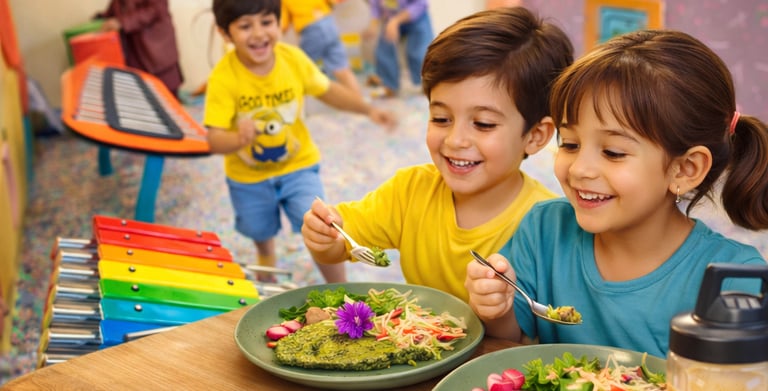
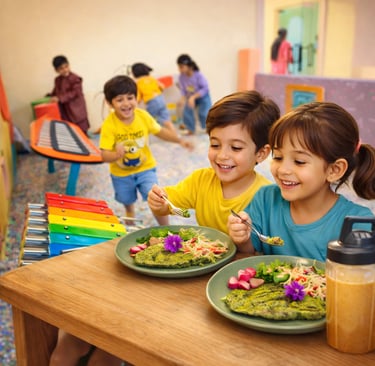
So instead of occasional efforts, we organised our kitchen to consistently prepare simple protein-based food after play. Over time, this naturally evolved into what we now call Play & Protein.
The idea is not to turn a play space into a health program. Children do not need lectures about nutrition. They learn habits through routine. When active play is naturally followed by proper food, the association forms quietly on its own.
Over the year, we have realised that children do not separate experiences the way adults do. For them, play, food, rest and interaction are part of one environment. What they repeatedly experience becomes normal.
If a child plays and is then handed a packet snack, that becomes normal.
If a child plays and then drinks water and eats real food, that also becomes normal.
The difference is not instruction.
The difference is exposure.
Play Diaries cannot replace a home or a school, and it is not meant to. Our role is small. We host families for a few hours. But even within that short time, an environment can gently shape habits without rules.
The decision to add nourishment alongside play came from this thought — not to create strict routines, and not to promote food, but to complete the experience of activity and recovery in a natural way.
Children already know how to play.
Sometimes they only need adults to quietly prepare what comes after.
If a child leaves Play Diaries happy, tired in a good way, hydrated and properly nourished, we feel the visit has served its purpose.
— Rajesh Kumar
Founder, Play Diaries
Planovative Diaries LLP
Engaging children through imaginative and sensory play.
Contact us
subscribe
contact@playcafediaries.in
© 2024. All rights reserved.